That ‘Knot’ in Your Shoulders Isn’t a Knot: Why Your Stiff Upper Back Is the Real Problem

If you constantly feel a nagging “knot” between your shoulder blades or chronic tightness in your neck, you might be treating the symptom instead of the cause. No amount of massaging, stretching, or cracking your neck will provide lasting relief if the real issue is a stiff, immobile thoracic spine (your upper and mid-back). The result is a frustrating cycle of temporary fixes for a problem that never truly goes away.
The solution isn’t to chase the pain—it’s to restore mobility where it’s been lost. When you consistently work on extending and rotating your upper back, you take the burden off the smaller, more sensitive muscles in your neck and shoulders. This allows them to finally relax, providing the long-term relief you’ve been looking for.
How a mobile upper back acts as the foundation for a healthy neck and shoulders.
Your body is a chain of interconnected segments. The thoracic spine is designed to be a mobile hub for rotation and extension. When it becomes rigid from hours of slouching over a desk or phone, that movement has to come from somewhere else. The areas above (the neck) and below (the lower back) are forced to compensate, leading to strain, pain, and injury.
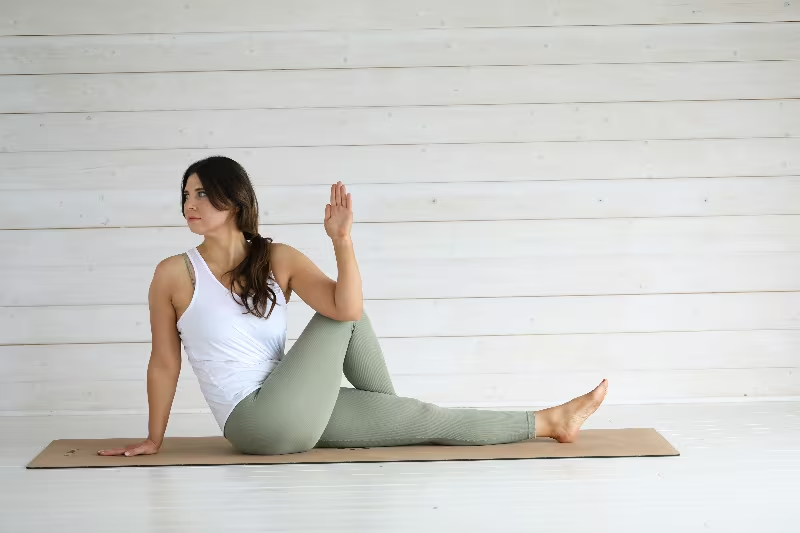
Think of your upper back as the rotating base of a turret. If the base is rusted shut, the turret itself (your neck and shoulders) has to strain to aim. Free up the base, and the entire structure moves effortlessly.
Below are three simple “pillars” for unlocking your upper back: restoring its natural ability to extend, improving its capacity for rotation, and integrating better movement habits into your day.


1. A healthy upper back needs to fight against gravity and extend.
Modern life is a constant battle against flexion (rounding forward). To have good posture and pain-free shoulders, you must actively practice thoracic extension. A true baseline of good posture is built by regularly taking your upper spine out of its slumped position and reminding it how to be straight and tall.
“We live in a world of flexion. Your phone, your desk, your car—they all pull you forward. The antidote is daily, conscious extension to remind your body what upright feels like.”
Postural Specialist
Try this: Lie on the floor with a foam roller positioned across your upper back, just below your shoulder blades. Support your head with your hands and gently allow your back to arch over the roller. Hold for 30 seconds, breathing deeply.



2. Small rotational drills provide instant relief and restore function.
Rotation is the primary job of the thoracic spine. When it can’t rotate, your body will steal that movement from your lower back (a common cause of disc issues) or your neck. The solution is targeted practice: use simple, controlled drills to teach your upper back how to twist again, freeing up the rest of the chain.
1. Better rotation improves shoulder health for reaching and lifting.
2. It allows you to turn your body without cranking on your neck.
3. It protects your lower back from dangerous twisting forces.
4. A few reps of quadruped t-spine rotations can feel like a miracle.

Once you reintroduce rotation, you’ll be amazed at how much tension melts away from your neck and shoulders. Their job gets easier because the upper back is finally doing its share of the work.
Have you tried working on your upper back?
I had chronic neck pain for years and spent a fortune on massages. My physio gave me two simple upper back rotation exercises to do daily. The pain was gone in a week. It was never my neck; it was my stiff back all along.

3. Integrating movement into your day prevents stiffness from returning.
A 5-minute routine is great, but true mobility is built by breaking up long periods of stagnation. Use micro-movements throughout your day to prevent your upper back from getting “stuck” in the first place.

Set a timer to stand up and reach your arms overhead every 30 minutes.
When you stand, gently twist side to side, leading with your chest.
Consciously pull your shoulder blades back and down whenever you notice you’re slouching.
Want a simple rule? Your neck and shoulders are the victims, but your upper back is often the culprit. Give it the movement it craves, and the entire system will thank you for it.