Your Brain on a 24/7 News Cycle: How to Stay Informed Without Losing Your Mind
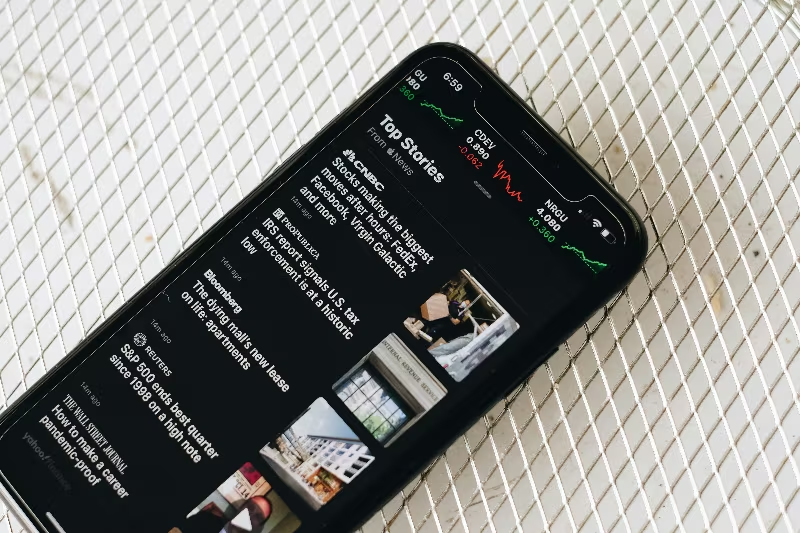
If you find yourself feeling perpetually anxious, angry, or pessimistic, the cause may not be the world itself, but your consumption of it. The modern information ecosystem—a relentless firehose of breaking news alerts, social media outrage, and algorithm-driven content—is designed to keep you engaged. But the currency of engagement is often your own peace of mind.
The solution isn’t to become uninformed or bury your head in the sand. It’s to shift from being a passive consumer to an intentional one. When you consciously curate your information diet and create boundaries with technology, you reclaim your mental space from the chaos. This allows you to stay engaged with the world from a place of stability, not stress.
Why the constant stream of information is a form of mental junk food that leaves you drained.
Your brain is wired with a negativity bias, an evolutionary trait that makes you pay more attention to threats than to positive news. Modern media algorithms exploit this trait, feeding you a steady diet of conflict, crisis, and outrage because it reliably captures your attention. This keeps your nervous system in a constant state of low-grade “fight or flight,” flooding your body with stress hormones like cortisol and leaving you feeling exhausted and emotionally fragile.

Think of your attention like a garden. If you let anyone and everyone throw seeds into it, you’ll end up with a tangled mess of weeds. Curating your information is the act of mindfully tending to your garden, ensuring you’re planting what you actually want to grow.
Below are three simple “pillars” for creating a healthier information diet: actively curating your sources, creating friction to prevent mindless consumption, and scheduling time for intentional disconnection.


1. A true fix starts with treating your information like your diet.
You wouldn’t eat junk food for every meal, yet many of us consume low-quality, anxiety-inducing information all day long. The first step is to become a conscious curator. A true baseline of mental clarity is built by choosing your sources deliberately, prioritizing depth over breadth, and eliminating what doesn’t nourish you.
“What you pay attention to is what your life will become. The most valuable currency you have is not your money, but your focus.”
James Clear
Try this: Do a one-week “information audit.” For every account you follow or newsletter you read, ask: “How does this consistently make me feel?” If the answer is anxious, angry, or inadequate, hit unfollow or mute. Replace it with a source that is thoughtful, nuanced, or inspiring.



2. Small points of friction can break the cycle of mindless scrolling.
Modern apps are designed to be frictionless, pulling you in with endless scrolling and autoplay. The habit of checking is often unconscious. The solution is intentional friction: add small, simple barriers that force you to be conscious of your choice to consume information.
1. Turn off all notifications except from human beings.
2. Move news and social media apps off your home screen into a folder.
3. Set time limits on apps that drain your energy.
4. This small pause is often enough to make you ask, “Do I really want to do this now?”

Once you make consumption an active choice instead of a passive habit, you’ll find yourself reaching for your phone far less often. You reclaim your attention from the algorithm.
Have you tried curating your information diet?
I used to start my day by scrolling through news headlines and would feel anxious before I even got out of bed. I deleted all news apps and now only read a weekly summary newsletter. The change has been incredible. I’m still informed, but I’m no longer marinating in negativity.

3. The real peace comes from scheduled, intentional disconnection.
Your brain needs time completely free from new inputs to process information, consolidate memories, and recover. You must create sacred, tech-free time and space in your day. This is not an optional luxury; it’s a cognitive necessity.

Implement a “digital sunset”: no screens for at least an hour before bed.
Create a central charging station for all devices outside of the bedroom.
This practice dramatically improves sleep quality and reduces ambient anxiety.
Want a simple rule? Be the gatekeeper of your own mind. Don’t outsource your peace and attention to an algorithm designed to steal it.